After completing her MSc in Computer and Electronic Engineering at Pázmány, Borbála earned her PhD at KU Leuven, continued as a postdoctoral researcher there, and later joined TU Delft as an assistant professor through the highly competitive Delft Technology Fellowship programme. In 2024 she received the prestigious NWO Vidi grant for her project “NeuroMark”. As of 2025, she has joined Maastricht University’s Faculty of Health Medicine and Life Sciences.
Her research lies at the intersection of signal processing, machine learning, and clinical neuroscience, with a particular focus on understanding epilepsy through advanced neuroimaging techniques (EEG, fMRI, fUS).
Keynote lecture: Tensor Signal Processing for Clinical Neuroscience
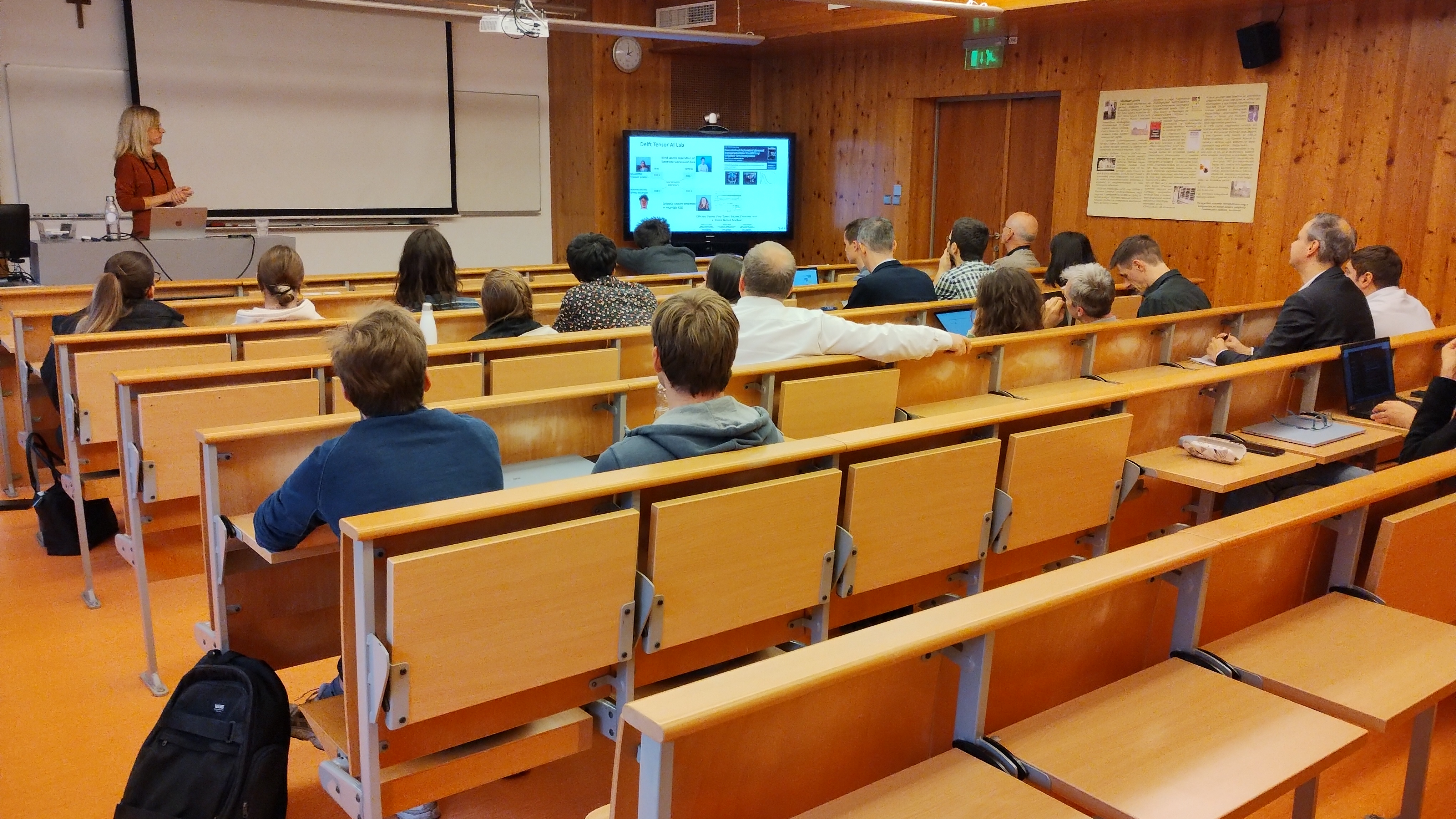
Borbála opened her visit with a public lecture titled “Tensor Signal Processing for Clinical Neuroscience”, presenting cutting-edge methods for analysing high-dimensional brain data through tensor decompositions.
She highlighted how tensor-based approaches allow researchers to compress, interpret, and extract meaningful patterns from complex multimodal neuroimaging signals — enabling a deeper understanding of healthy and pathological brain function.
The talk drew significant interest from students and staff alike, given its strong relevance to the Faculty’s core strengths in bioinformatics, biomedical signal processing, medical AI, and neural engineering.
Two days of vibrant academic exchange
Following the lecture, Bori took part in an intensive two-day programme of lab tours and research discussions with numerous faculty members and research groups. These meetings explored future joint research directions, student mobility paths, and potential teaching collaborations.
The visit clearly demonstrated the wide range of areas where our institutions can join forces, from tensor-based AI and biomedical pattern recognition to neuromorphic engineering and advanced signal analytics. The conversations also supported ongoing efforts to establish a bilateral Erasmus partnership with Maastricht University, which could enable joint teaching opportunities and student exchanges in the near future.
A proud moment for the Faculty
Hosting Dr. Hunyadi was a great honour for us. Her visit highlighted how the scientific foundations built at Pázmány can lead to outstanding international academic careers, and it served as an inspiration to our student community.
We are immensely proud of Borbála’s achievements and are confident that her visit marks the beginning of an even closer collaboration between our Faculty and Maastricht University.
We look forward to future joint projects and academic exchanges.