
Head of the Research Group: Dr. Márton Áron GODA
Members of the Research Group: Dr. Janka HATVANI, Bálint KRISTÓF, Kristóf MÜLLER, Szabolcs Mátyás PÉTER
Contact: goda.marton.aron@itk.ppke.hu
Wearable devices have become a key part of modern healthcare, enabling home monitoring and the tracking of fitness, stress, and potential heart conditions, while providing valuable insights for clinical care and everyday health management. Our lab focuses on developing standardized, robust, and validated solutions for medical signal processing to support next-generation AI-powered healthcare technologies. Traditional fetal monitoring methods, such as ultrasound and cardiotocography, have limitations for longterm and home-based monitoring. Fetal phonocardiography (fPCG) provides a simple, cost-effective alternative. Our research focuses on fPCG signals and ultrasound imaging. We developed pyPCG, a validated Python toolbox for the advanced analysis of fPCG signals.
Heart pulse monitoring is essential for cardiovascular assessment and arrhythmia detection using technologies such as ECG, pulse oximetry, smartwatches, and chest straps. These methods also have potential for biometric identification. In collaboration with the Technion – Israel Institute of Technology and the University of Cambridge, we developed pyPPG, an open-source toolbox for photoplethysmography analysis, supporting future clinical applications such as heart failure prediction and risk assessment.
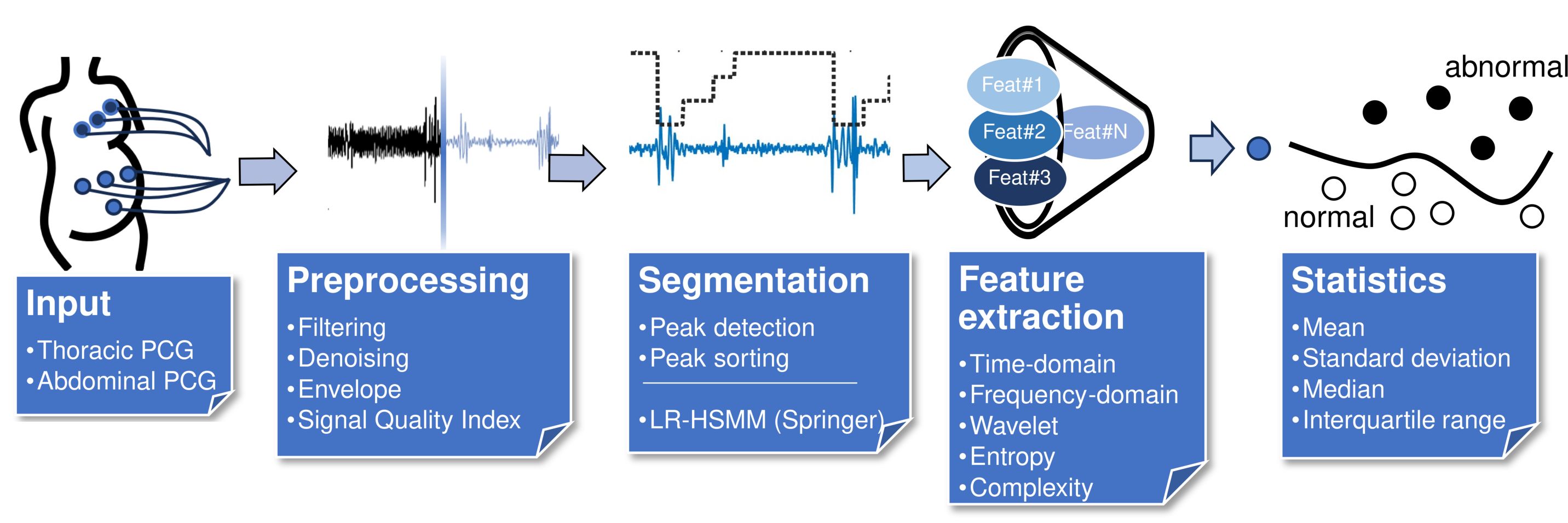
Major pyPCG steps and implemented functionality.
Future research directions, collaboration opportunities
The AIMS Lab welcomes collaborations in AI-based medical signal processing, wearable health technologies, and digital health innovation. We actively engage in joint research projects, clinical validation studies, open-source software development, and national and international grant proposals with academic, clinical, and industrial partners.
Key publications
- Goda, M. Á., Charlton, P. H., & Behar, J. A. (2024). pyPPG: a Python toolbox for comprehensive photoplethysmography signal analysis. PHYSIOLOGICAL MEASUREMENT, 45(4), 045001.
- Müller, K., Hatvani, J., Koller, M., & Goda, M. Á. (2024). pyPCG: a Python toolbox specialized for phonocardiography analysis. PHYSIOLOGICAL MEASUREMENT, 45(12), 125007.
- Hatvani, J., Horváth, A., Michetti, J., Basarab, A., Kouamé, D., & Gyöngy, M. (2018). Deep learning-based super-resolution applied to dental computed tomography. IEEE TRANSACTIONS ON RADIATION AND PLASMA MEDICAL SCIENCES, 3(2), 120-128.