Head of the Research Group: Dr. József LACZKÓ
Members of the Research Group: Dr. Lilla BOTZHEIM, Dr. Mariann MRAVCSIK, Balázs RADELECZKI, Amelita FODOR
Contact: laczko.jozsef@itk.ppke.hu
The laboratory investigates how the central nervous system controls human limb movements for the well-coordinated execution of motor tasks. Such tasks include, for instance, reaching for a target with the arm, transporting an object held in the hand, or performing cycling movements with the lower or upper limbs.
We use movement-analysis systems to record kinematic and electromyographic data during human limb movements. Markers are placed on anatomical landmarks, and their positions are recorded. Simultaneously, muscle activities are measured using surface electromyography (EMG). A particular interest of the laboratory is functional electrical muscle stimulation and its application in the rehabilitation of paralyzed people with spinal cord injuries. We continue our research in cooperation with colleagues from the Wigner Research Centre for Physics and apply our findings at the National Institute for Medical Rehabilitation.
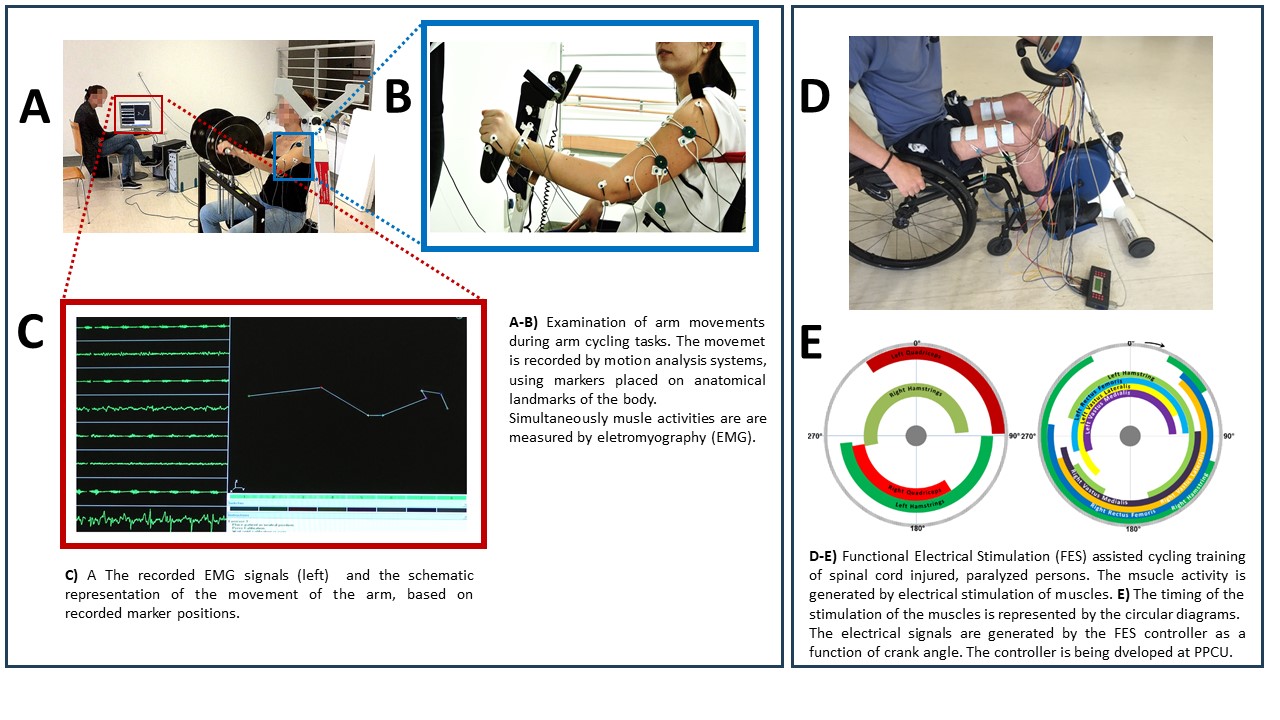
The figure illustrates different aspects of our research, from data recording and exploratory research (Panels A–C) to practical applications (Panels D–E). Our goal is to improve the rehabilitation and living conditions of motor impaired people through the joint application of informatics and the natural sciences.
Key publications
- Radeleczki, B., Mravcsik, M., Bozheim L. and Laczko, J. (2023). Prediction of leg muscle activities from arm muscle activities in arm and leg cycling THE ANATOMICAL RECORD 306(4) pp. 710-719.
- Botzheim, L., Laczko, J., Torricelli, D., Mravcsik, M., Pons, J. L. and Barroso, F. O. (2021). Effects of gravity and kinematic constraints on muscle synergies in arm cycling JOURNAL OF NEUROPHYSIOLOGY 125(4) pp. 1367-1381.
- Mravcsik, M., Klauber, A., Putz, M., Kast, C., Mayr, W. and Laczko, J. (2019). Tricycling by FES of quadriceps muscles leads to increased cycling speed over series of trainings of persons with flaccid paraplegia PROCEEDINGS OF THE 13TH VIENNA FES WORKSHOP pp. 133-135.