
Head of the Research Group: Prof. József Balázs RÓZSA
Members of the Research Group: Dr. Levente CSERI, Dr. Attila CSOMOS, Dr. Flóra Zsófia FEDOR, Anna JÁSZ, Dr. Viktória KISS, Bálint KOCSIS, Dr. Ervin KOVÁCS, Tibor LŐRINCZ, Dr. Miklós MADARÁSZ, Dr. Zoltán MUCSI, Dr. Dénes PÁLFI, Dr. Linda SULCZ-JUDÁK, Dr. Gergely SZALAY, Katalin WÉBER
Contact: rozsabal@femtonics.eu
Our laboratory aims to make brain function visible and controllable at a new level through state-of-the-art imaging and photostimulation technologies. At the core of our work is 3D two-photon microscopy, which enables real-time investigation of neuronal network activity with high spatial and temporal resolution. The microscopes developed by Femtonics Ltd., together with 3D acousto-optic scanning technology, significantly increase measurement speed and signal quality, while online motion correction allows precise recordings even in moving, behaving animals.
Our research focuses on uncovering previously unknown brain signaling systems that shape reward, punishment, decision-making, and learning across the neocortex and hippocampus. A key priority is the development of targeted photostimulation methods that open new possibilities for causal investigation of neuronal networks. Within BrainVisionCenter, and in collaboration with Botond Roska, we also contribute to human retinal measurements. The laboratory conducts two-photon microscopy-based acute animal experiments and cell culture studies in a strictly controlled, legally compliant environment. Our work is driven by innovation, technological excellence, and a translational vision.
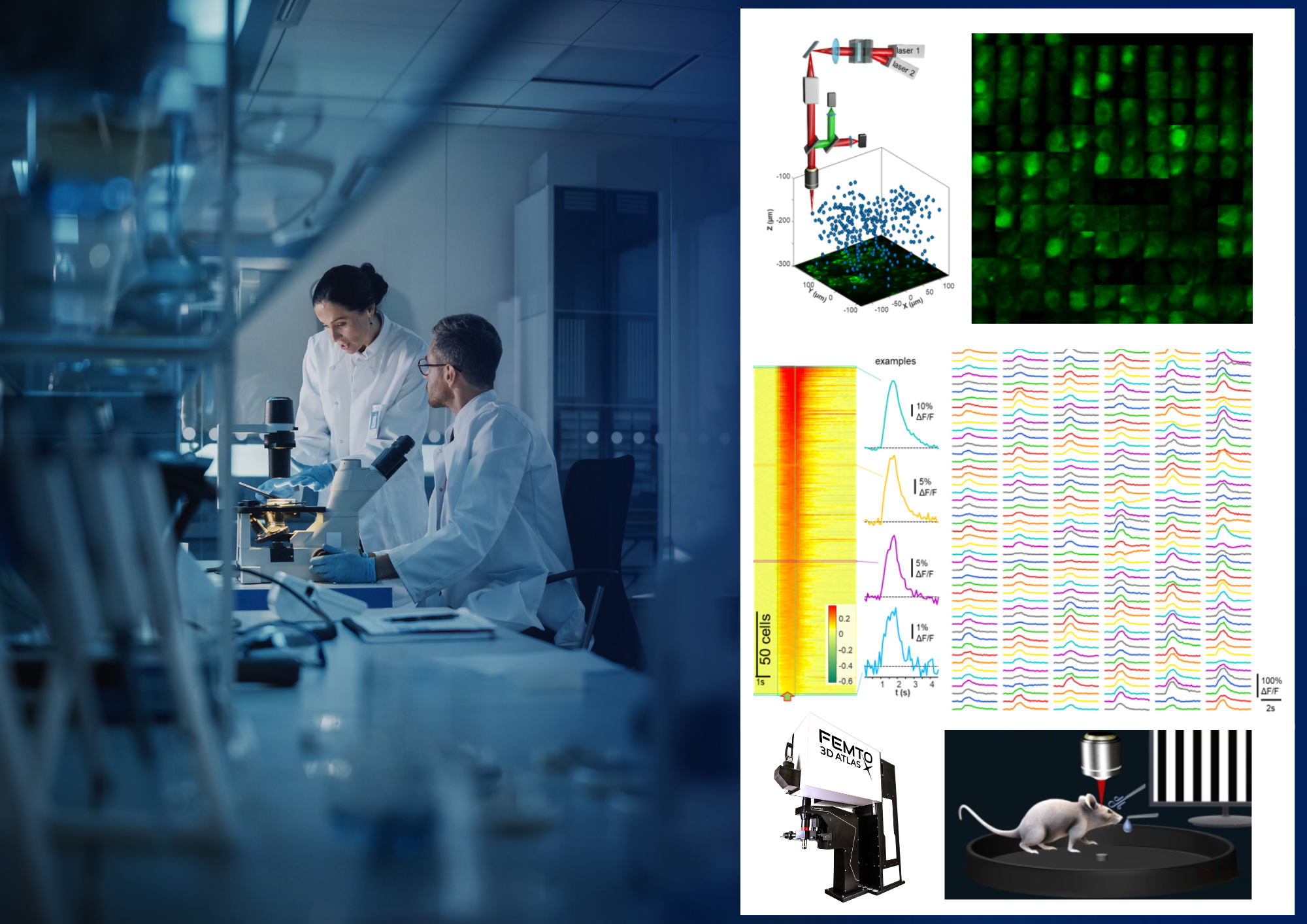
The 3D two-photon microscopy and photostimulation technologies open new possibilities for real-time, cellular-level investigation and targeted modulation of neuronal networks.
Future research directions, collaboration opportunities
Our research group offers collaboration opportunities in advanced 3D two-photon imaging, photostimulation, acute animal experiments, and cell culture studies. We are open to joint basic and translational research projects, technology development partnerships, and participation in national and international grant applications.
Key publications
- Gonzalez, Kevin C., et al. (2026). Movement-stabilized three-dimensional optical recordings of membrane potential changes and calcium dynamics in hippocampal CA1 dendrites. NEURON, 114 .10,1818-1832.
- Judák, L., Dobos, G., Ócsai, K., Báthory, E., Szebik, H., Tarján, B., ... & Rózsa, B. (2025). Moculus: an immersive virtual reality system for mice incorporating stereo vision. NATURE METHODS, 22(2), 386-398.
- Judák, L., Chiovini, B., Juhász, G., Pálfi, D., Mezriczky, Z., Szadai, Z., ... & Rózsa, B. (2022). Sharpwave ripple doublets induce complex dendritic spikes in parvalbumin interneurons in vivo. NATURE COMMUNICATIONS, 13(1), 6715.