
Head of the Research Group: Prof. György CSEREY
Members of the Research Group: Zsófia BEKŐ, Dr. Sándor FÖLDI, Péter András HERING, Dorka KECSKÉS, Dr. Miklós KOLLER, Botond MÓZSIK, Márton Bese NASZLADY, Szilárd SZATMÁRI, Henrik STURCZ
Contact: cserey.gyorgy@itk.ppke.hu
The Prosthetics Lab develops biomimetic artificial limbs, wearable human–machine interfaces, and technologies supporting their industrialization and scalable manufacturing. Its core research focuses on humanoid robotic hands for prosthetic and teleoperation/ industrial applications, integrating advanced manufacturing and textile technologies. Another major area is rehabilitation robotics, particularly the development of a soft robotic exoskeleton using the Faculty’s emulated elastic actuator (“software spring”) for habilita-tion and rehabilitation, supported by AI-driven control systems. The lab also investigates digital twins for personalized rehabilitation by integrating movement, physiological, and sensor data to optimize therapy and monitor recovery. Research extends to AI- and robotics-enabled rehabilitation environments with intelligent sensing, fall detection, physiological monitoring, and caregiver support for hospitals, rehabilitation centers, nursing homes, and home care . Additional work includes multimodal AI assistants for people with disabilities, providing communication, navigation, and health monitoring support . The lab also conducts AI-based movement analysis, combining sensor and computer vision data for objective rehabilitation assessment, personalized feedback, and applications in sports performance and injury prevention.
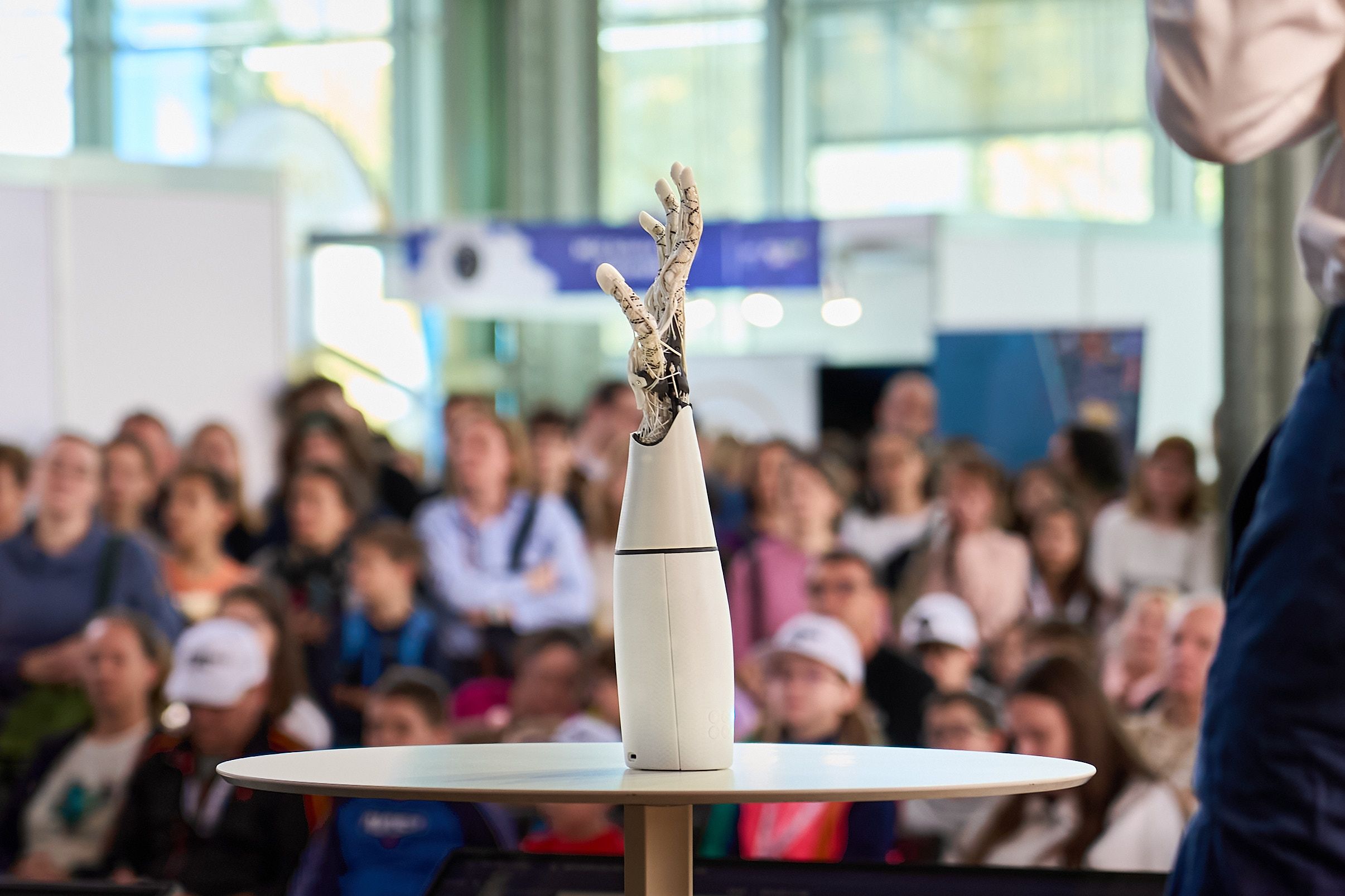
Biomimetic prosthetic hand. (Allonic Inc.)
Future research directions, collaboration opportunities
The Prosthetics Lab collaborates on AI-driven rehabilitation, personalized digital twins, intelligent assistive environments, accessible AI technologies, advanced prosthetics and exoskeletons, and objective movement analysis. Joint research integrates robotics, biosensors, computer vision, and human–machine interfaces to improve rehabilitation, independent living, and clinical decision support.
Key publications
- Csigó, K. and Cserey, Gy. (2026). Human Shadows in Machine Minds: Quantitative Study Interpreting AI Responses to the Rorschach Test. JMIR MENTAL HEALTH 13 .1, e88186.
- Endrei, T., Földi, S., Makk, Á., & Cserey, G. (2025). Learning to suppress tremors: a deep reinforcement learning-enabled soft exoskeleton for Parkinson’s patients. FRONTIERS IN ROBOTICS AND AI, 12, 1537470.
- Tasi, B. J., Koller, M., & Cserey, G. (2019). Design of the anatomically correct, biomechatronic hand. ARXIV PREPRINT ARXIV, 1909.07966.