
Head of the Research Group: Dr. Miklós KOLLER
Members of the Research Group: Prof . György CSEREY, Dr . Sándor FÖLDI, Dr . Gergely FELDHOFFER, Dr . Janka HATVANI, Dr . Dániel HAJTÓ, Márton Bese NASZLADY, Boldizsár BALOG, Attila RÉPAI, Rizal MAULANA, Zsombor Ágoston MICSKÓ, Eszter BIRTALAN, Réka KISS, Áron Boldizsár KÖVES, Marvin Serge FUENTES, Zsuzsanna ROHÁN, Liza KONDRÁT, Bálint SZALAI-BENEDEK, Zalán TARI, Benedek VARGA, Réka FÉLEGYHÁZI-TÖRÖK, Regő László SZABÓ, Katalin JUHÁSZ, Zita BARDOCZY
Contact: koller.miklos@itk.ppke.hu
Our laboratory develops intelligent sensing, modeling, and machine learning methods at the intersection of biomedical engineering, robotics, and industrial applications. A major focus of our research is the development of advanced human–machine interfaces, with particular emphasis on sensing and control solutions for hand prostheses. We investigate optimal sensor configurations, develop high-density electromyography (HD-EMG) acquisition systems and signal decomposition algorithms, and model muscle activation and metabolic processes using near-infrared spectroscopy (NIRS). We also conduct research on diffuse optical tomography for measurement and data evaluation, as well as on vascular signal recording and pulse diagnostics, integrating both hardware and software solutions.
In robotics, we reconstruct industrial optical assembly workstations in both physical and simulation environments and investigate Vision-Language-Action (VLA)-based robotic manipulation . Our virtual reality research includes the development of systems for divers that reconstruct underwater environments from sonar measurements.
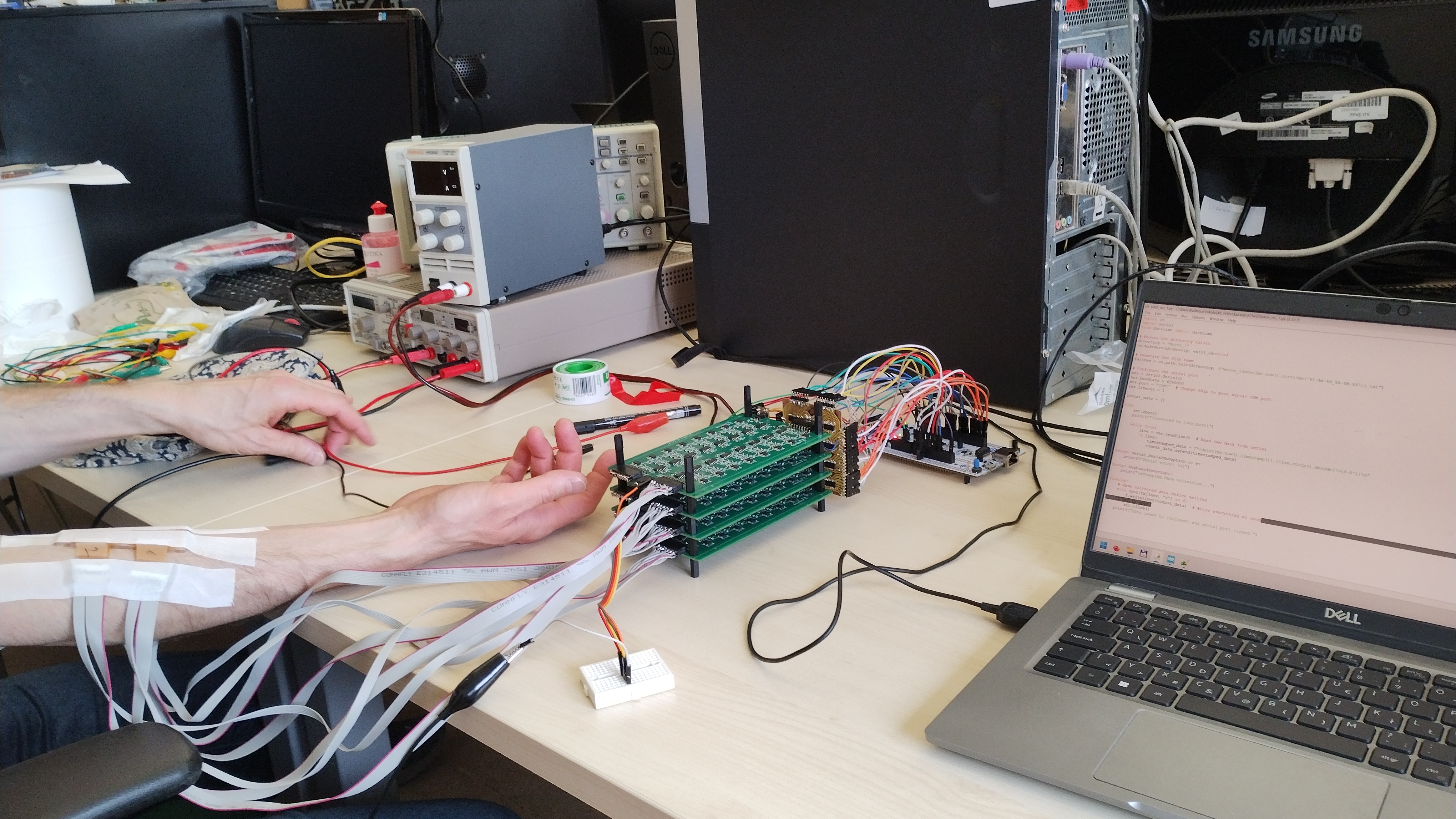
High-density electromyographic measurement with the in-lab-developed device.
Future research directions, collaboration opportunities
Based on our research focus, we offer professional cooperation in the following fields: smart medical devices for home monitoring and cardiovascular risk detection; intelligent prosthetics, exoskeletons, and human–machine interfaces; and AI-based control algorithms.
Key publications
- Birtalan, E., Koller, M. (2026). The impact of tactile sensor configurations on grasp learning efficiency--a comparative evaluation in simulation. ARXIV PREPRINT ARXIV, 2601.10268.
- Polcz, P., Schäffer, K., Koller, M. (2024). Posture estimation for a high degree of freedom anthropomorphic tendon-based hand model–A simulation experiment. EUROPEAN CONTROL CONFERENCE
- Ignácz, A., Földi, S., Sótonyi, P., Cserey, Gy. (2021). NB-SQI: A novel non-binary signal quality index for continuous blood pressure waveforms. BIOMEDICAL SIGNAL PROCESSING AND CONTROL, 70: 103035.