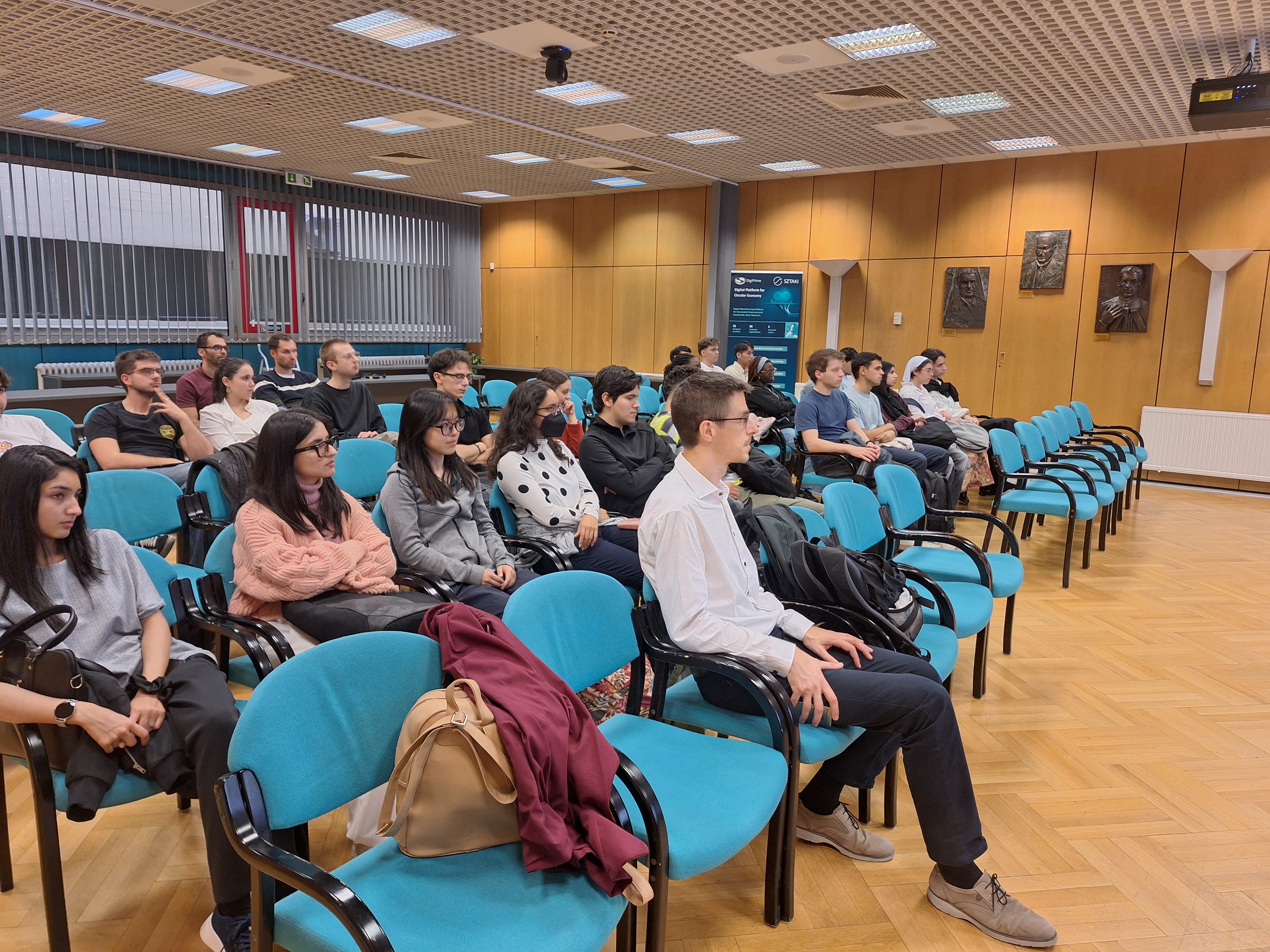
Students in Pázmány ITK’s international master’s programme in Image Processing and Computer Vision (IPCVai) visited SZTAKI to learn about the latest developments in artificial intelligence, machine perception, and robotics, and to see how the concepts they study can be applied in real-world research and technological development. Researchers from SZTAKI’s Machine Perception Research Laboratory (MPLAB), Engineering and Business Intelligence Research Laboratory (EMI) and the Systems and Control Lab (SCL) introduced the students to their current work, focusing in particular on computer vision, sensor fusion, real-time spatial perception and the control of autonomous systems.
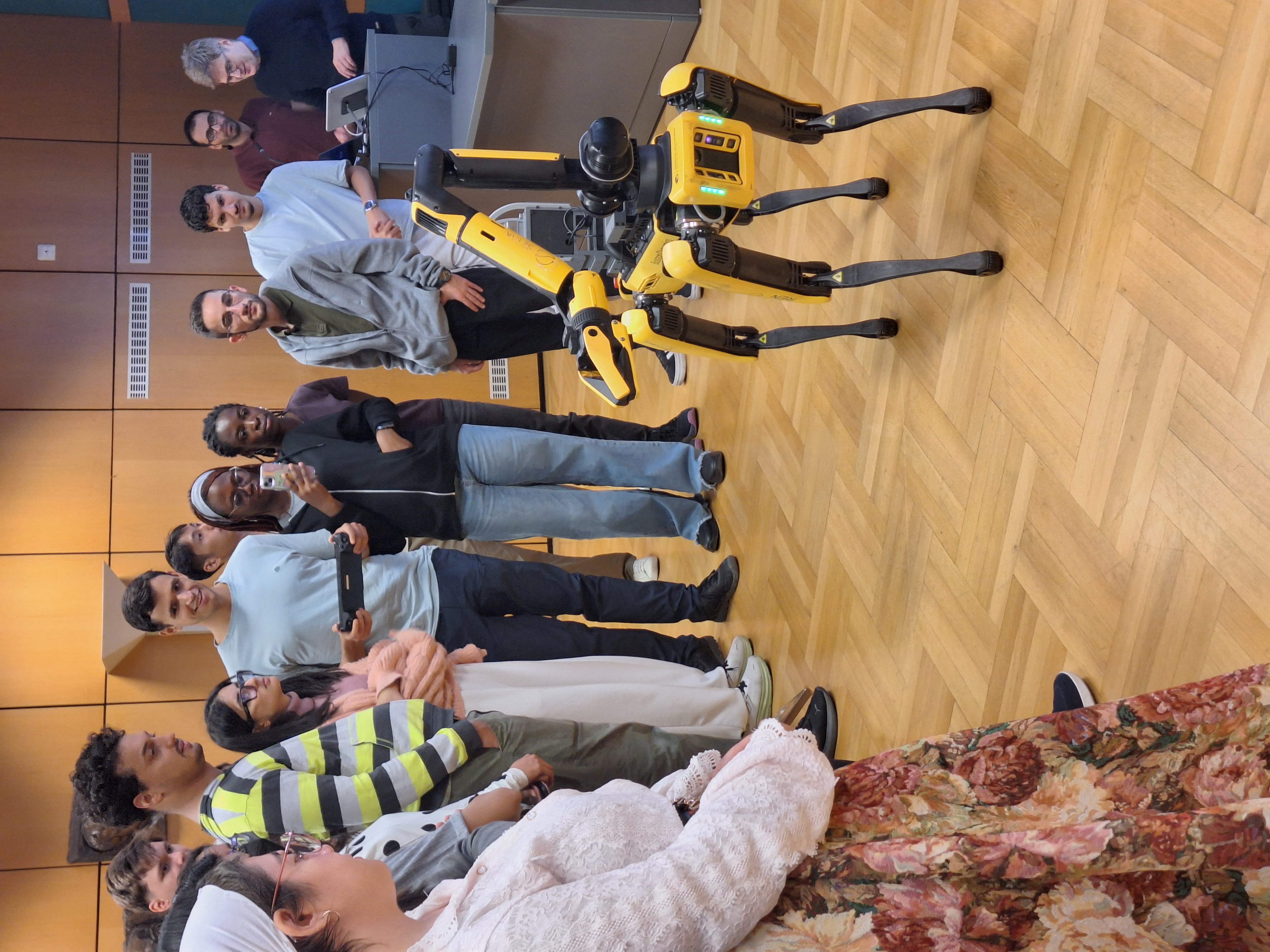
The visit went beyond presentations. The students also had the chance to experience some of the technologies in action and explore how AI-powered perception enables robots to interact with their environment. One highlight was SPOT, Boston Dynamics’ quadruped robot, whose capabilities in terrain navigation, dynamic balancing, and real-time sensing were demonstrated to the group. They had the opportunity to meet Bob, the humanoid robot, and another fascinating demonstration featured the Piktor-o-bot, a portrait-drawing robot developed by the EMI laboratory. The students saw how computer vision algorithms designed to detect faces and edges translate into precise robotic-arm movements, ultimately producing a physical portrait.
For the IPCVai students, the visit was an opportunity to take their knowledge of image processing and AI beyond the classroom and experience its practical applications in a cutting-edge research environment. It also gave them the chance to meet researchers working in the field, ask questions and gain a better understanding of current challenges and emerging directions in robotics and artificial intelligence.
The close connection between education and research is an important part of the IPCVai experience. In this respect, SZTAKI can provide an excellent environment for students to complete their professional internships and, in the longer term, to become involved in joint research and development projects. SZTAKI is delighted to welcome IPCVai students for their fourth-semester professional internships and looks forward to opportunities to engage with them beyond the programme, including as future PhD students and research partners.