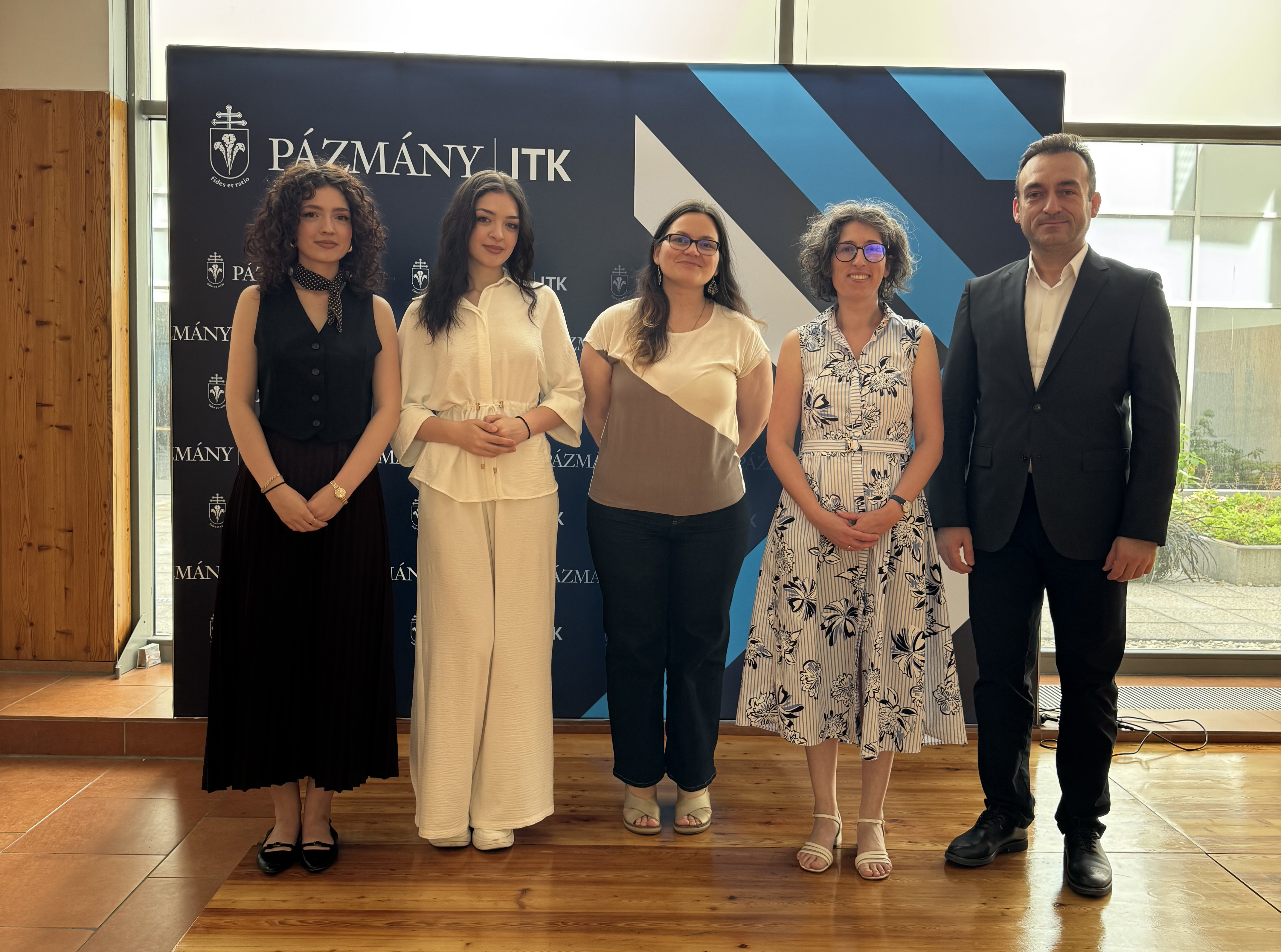

On the afternoon of February 13, we held a training session for members of the International Mentor Community. The goal of this session was to prepare the team professionally and strengthen our community as we began the spring semester.
Last Friday, the Faculty of Information Technology at Pázmány Péter Catholic University (Pázmány ITK) hosted the invitation-only professional final conference of the Epidemic Mathematics Division of the National Laboratory for Health Security.
The following report was prepared on the Visegrad Project kick-off meeting and contains the project leader’s summary of the opening event held in Budapest on 28 January 2026. The meeting was hosted by the Faculty of Information Technology and Bionics of Pázmány Péter Catholic University.
We are delighted and proud to announce that two of our distinguished lecturers at Pázmány Péter Catholic University were appointed as university professors on February 10 in Budapest, at a ceremonial event held at the Sándor Palace, the official residence of the President of Hungary.
Last Friday, the social life of the spring semester began with a fun of bowling. The semester-opening bowling event featured not only newly arrived Erasmus+ students but also Hungarian and international students starting their master’s programs in February. This gathering provided a great opportunity for everyone to meet and connect with one another.
It started as a university project and became an international breakthrough in robotics. Benedek Tasi, a former student of our Faculty, and his team developed a bio-inspired manufacturing technology that could fundamentally transform robotics. Allonic now works with the world's leading engineers, while its roots go back to the creative, experimental environment of Pázmány ITK.
Artur Sahakyan, a Computer Science Engineering MSc student at the Faculty, recently achieved first place in the regional round of the prestigious International Quant Championship, a global competition in quantitative analysis and data science. In this interview, Artur discusses his path from Armenia to Hungary, his academic interests, his experience in the competition, and his vision for the future. His academic journey and international mindset reflect the strengths of Pázmány ITK’s English-taught, research-oriented master’s programmes, showing how strong academic foundations, international experience and curiosity can lead to outstanding achievements.
A high-impact publication has been published in the prestigious journal Advanced Healthcare Materials with the active contribution of researchers and students from our Faculty.
Hybrid Nanofibers for Multimodal Accelerated Wound Healing
Viraj P. Nirwan, Bence Bajusz, Norbert Fabók, Marina Rudan Dimlic, Jelena Budimir, Tshepang Mqatywa, Miklós Gyöngy, Márton Ferencz, Dorottya Kocsis, Olexandr Bondarenko, Mariia Rolduhina, Milena Lengyel, Istvan Antal, Rebecca Hengsbach, Franciska Erdő, Amir Fahmi
A high-impact publication has been published in the prestigious journal Advanced Healthcare Materials with the active contribution of researchers and students from our Faculty.
Hybrid Nanofibers for Multimodal Accelerated Wound Healing
Viraj P. Nirwan, Bence Bajusz, Norbert Fabók, Marina Rudan Dimlic, Jelena Budimir, Tshepang Mqatywa, Miklós Gyöngy, Márton Ferencz, Dorottya Kocsis, Olexandr Bondarenko, Mariia Rolduhina, Milena Lengyel, Istvan Antal, Rebecca Hengsbach, Franciska Erdő, Amir Fahmi